
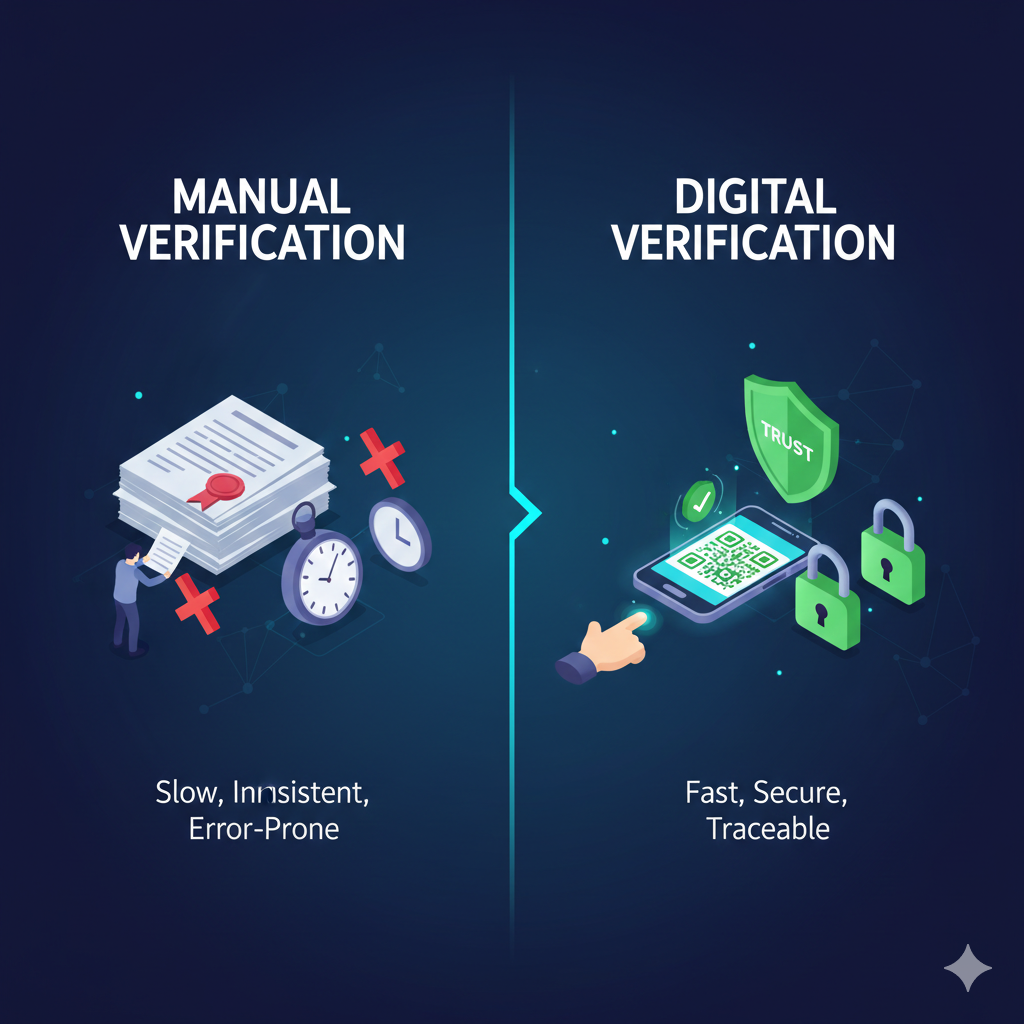
Manual verification often depends on email back-and-forth, office hours, and human judgment. This makes it slow, hard to scale, and inconsistent across departments or locations.
The hidden cost of manual verification
Manual verification seems “free” because it uses existing staff. But it creates delays, context switching, and rework—more it often fails silently when teams are overloaded.
Manual verification: where it breaks
Manual checks can work for small volumes, but the moment requests grow, teams create informal shortcuts. That is when inconsistency and risk appear.
- Long turnaround times (days, sometimes weeks)
- No standard response format; each staff member replies differently
- Difficult to verify documents coming from multiple campuses or departments
- Hard to track whether the credential was later corrected or revoked
Digital verification: what changes
Digital verification provides a single source of truth that can be checked in seconds, with an auditable trail of issuance and status changes. It standardizes what “verified” means.
A quick comparison
- Speed: seconds vs days
- Consistency: same fields and same status logic every time
- Security: issuer-controlled record vs editable files
- Governance: roles/permissions and audit logs vs inbox approvals
Benefits that matter in real operations
- Instant results for employers and partners (self-serve verification)
- Consistent data fields (name, program, dates, issuer) across all credentials
- Auditability: clear logs for issuance, changes, and verification events
- Status control: valid / expired / revoked managed by the issuer
A simple decision rule
If your organization receives repeated verification requests, issues a growing number of credentials, or works with external partners (employers, agencies, scholarship bodies), digital verification becomes a necessity—not a nice-to-have.
How to transition without disruption
Most organizations do not “rip and replace”. A practical transition starts with new issuances, then expands.
- Phase 1: issue new credentials with QR verification
- Phase 2: enable status control and standardize required fields
- Phase 3: integrate verification into admin workflows and reporting
- Phase 4: migrate high-value legacy cohorts (optional)
A simple implementation roadmap (30-60-90 days)
If you need a realistic plan, think in stages. Start with a working system first, then improve governance.
- 0-30 days: launch verification pages + QR issuance for new credentials
- 30-60 days: add status lifecycle (expired/revoked) + standardize fields
- 60-90 days: add reporting, logs, role-based permissions, and batch workflows
Where ROI comes from
The ROI is usually not “new revenue”. It is saved time, reduced risk, and improved partner confidence.
- Less manual verification handling (fewer emails, fewer calls)
- Faster hiring/admissions decisions (less waiting)
- Lower fraud expoofe and fewer disputes
- Stronger governance for audits and compliance
FAQ (quick answers)
Do we need blockchain for digital verification?
Not necessarily. What matters is an issuer-controlled source of truth, tamper resistance, and live status. Many strong systems achieve this without blockchain.
How do we prove verification happened?
Use logs: when a credential is issued, updated, revoked, and verified. This creates traceability for audits and disputes.
For organizations, the biggest win is reliability: the same verification process works every time, for every verifier.
Leave a Reply
Your email address will not be published. Required fields are marked *